
What Does “Prepared” Actually Mean for a School
A school can have an emergency operations plan, completed drills, annual training, and new safety technology, yet still struggle when a real incident disrupts normal operations. That gap explains why school leaders need to ask a harder question than whether a plan exists. They need to ask whether the organization can actually demonstrate preparedness.
Preparedness is not a binder on a shelf. It is not a single drill, a compliance checklist, or a product purchase. Preparedness is an organizational capability. It is the ability to take planning, people, systems, training, resources, and relationships, then make them work under difficult and uncertain conditions.
This article explains what “prepared” actually means for a school, and how K-12 leaders can move from written intentions to demonstrated capability.
Table of Contents
What School Preparedness Really Means - Preparedness is something a school demonstrates - Why having a plan is not enough
Preparedness Starts With Planning - Use the federal school EOP framework - Treat the plan as a hypothesis
Prepared Schools Build Capability Across People and Systems - People understand their roles - The organization shares a common language - Systems work together under pressure - Communication still works when conditions are imperfect - Community partners are actual partners
Preparedness Goes Beyond the Initial Response - Practice decisions, not just actions - Plan for accountability, reunification, continuity, and recovery
How Schools Evaluate and Improve Preparedness - Know your weaknesses - Improve, then test again
What School Preparedness Really Means
Ask almost any school leader whether their organization is prepared for an emergency and the answer is often some version of this: yes, we have a plan.
That answer matters. Schools need comprehensive emergency operations plans. They need written procedures, clearly defined protocols, and plans for evacuation, lockdown, sheltering, communication, reunification, continuity, recovery, and other hazards they may face. They also need to satisfy state and local requirements.
But those basics lead to a more important question: what does it actually mean for a school to be prepared?
A school is not prepared simply because it has an Emergency Operations Plan, completed required drills, installed technology, or shared floor plans with law enforcement. All of those steps can contribute to preparedness. None of them alone proves preparedness.
Preparedness is something a school demonstrates
Preparedness is not something an organization merely has. It is something an organization can demonstrate.
That means the school can take the planning, personnel, systems, training, resources, and relationships developed before an emergency and make them function when conditions become difficult, uncertain, and different from normal operations.
This is a higher standard than compliance. It asks whether the school can operate effectively, not just whether it has documented the right intentions.
Why having a plan is not enough
A written plan establishes what the organization intends to do. Preparedness is whether the organization has built the capability to do it.
That distinction appears throughout K-12 safety work. Schools may have procedures for communication, student accountability, incident command, and reunification. The challenge is whether people understand those procedures well enough to carry them out under stress, with incomplete information, and with competing demands across departments.
This principle aligns with the broader readiness mindset described in this guide to the mindset that makes school safety work. Preparedness becomes real when planning is connected to practice, evaluation, and improvement.
Preparedness Starts With Planning
There is no way around the importance of planning. A high-quality Emergency Operations Plan provides the foundation for response and recovery. It establishes what should happen, who is responsible, how decisions are made, how resources are coordinated, and how the organization transitions through response and recovery.
Use the federal school EOP framework
Federal guidance provides a practical framework for emergency planning. The Guide for Developing High-Quality School Emergency Operations Plans outlines six key steps:
Form a collaborative planning team
Understand the situation
Determine goals and objectives
Develop the plan and identify courses of action
Prepare, review, and approve the plan
Implement and maintain the plan
That final step matters. The framework does not end with writing the plan. It ends with implementing it through training, exercises, review, revision, and maintenance.
Schools that want stronger implementation can also explore guidance on building a culture of prevention, protection, and preparedness.
Treat the plan as a hypothesis
One useful way to think about an Emergency Operations Plan is as a hypothesis.
The plan says:
We believe this is how our organization will respond.
We believe this person will make this decision.
We believe this communication system will work.
We believe staff will understand this protocol.
We believe students can be accounted for.
We believe transportation can move students.
We believe law enforcement can access the building.
We believe Incident Command can be established.
We believe reunification can operate effectively.
Those assumptions may be reasonable, but until the school trains people, practices procedures, exercises systems, and evaluates performance, they remain assumptions. Prepared organizations test them.
Prepared Schools Build Capability Across People and Systems
Preparedness depends on how well people, departments, and systems work together. It is not enough for individual components to exist. They need to function as one operating system under pressure.
People understand their roles
Most employees will never memorize every page of the EOP, and they should not have to. Preparedness does not mean every employee knows the whole plan. It means people understand the parts of the system they are responsible for implementing.
For example:
Teachers should understand emergency actions, student accountability, expected communication, and what to do when normal procedures cannot be followed.
Administrators should understand decision-making authority, incident command, coordination, and management of an evolving incident.
Office staff may need to manage visitor procedures, emergency notifications, communications, and accountability support.
Transportation teams need clarity on evacuation support, student movement, relocation, and reunification.
Facilities personnel should understand utilities, building systems, shutdowns, access control, and responder entry.
District leaders should understand resource coordination, external communication, continuity, and recovery support.
The U.S. Department of Education describes training as an essential part of school emergency preparedness because it teaches staff the policies, procedures, roles, and responsibilities in the EOP. Exercises then allow participants to practice those courses of action.
Preparedness requires more than awareness of the plan. It requires understanding one’s role within it.
The organization shares a common language
Emergencies create confusion naturally. School systems should reduce confusion, not add to it.
That is why common language matters. When an emergency action is announced, people should understand what it means and what they are expected to do. Whether a school uses the Standard Response Protocol or another clearly defined framework, preparedness requires more than adopting terminology. The language has to become operational.
That means:
Teachers understand it.
Students receive age-appropriate instruction.
Substitutes can access it quickly.
Office staff know how to apply it.
Transportation understands how it applies off campus.
Athletics and extracurricular staff can use it outside the regular school day.
District leaders use the same terms.
Community responders understand what the school means.
Families receive communication that matches school protocols.
For organizations using shared response language, this discussion of lead training with the I Love U Guys Foundation offers relevant context on consistent protocol implementation.
A protocol printed on a poster is information. A protocol that thousands of people interpret consistently is capability.
Systems work together under pressure
Schools are complex organizations. Safety touches administration, emergency management, facilities, technology, communications, transportation, student services, mental health, special education, food service, athletics, human resources, first responders, and families.
A school can have strong individual systems and still experience major problems when those systems have to interact.
Consider evacuation. The school may know how to leave the building. But then what?
Where do students go?
How are they accounted for?
Who determines whether the evacuation area remains safe?
How does transportation become involved?
How does incident command receive accountability information?
What information goes to families?
When does evacuation transition to reunification?
How are students with disabilities supported throughout the process?
Preparedness lives in those connections between systems. Federal EOP guidance emphasizes collaborative planning for exactly this reason.
Communication still works when conditions are imperfect
Communication is one of the clearest tests of actual preparedness. A district may have an excellent mass-notification platform, but that alone does not guarantee an effective emergency communication system.
Prepared schools answer questions such as:
Who can initiate an emergency message?
What information do they need before sending it?
Who communicates with staff, families, and first responders?
Who handles media inquiries?
What happens if inaccurate information starts circulating?
What happens if the internet is unavailable?
What happens if cellular networks are overloaded?
What is the backup if the PA system cannot be heard in part of the building?
Technology can support communication. Preparedness is the organization’s ability to move accurate, actionable information to the right people when they need it, including when the preferred system does not work.
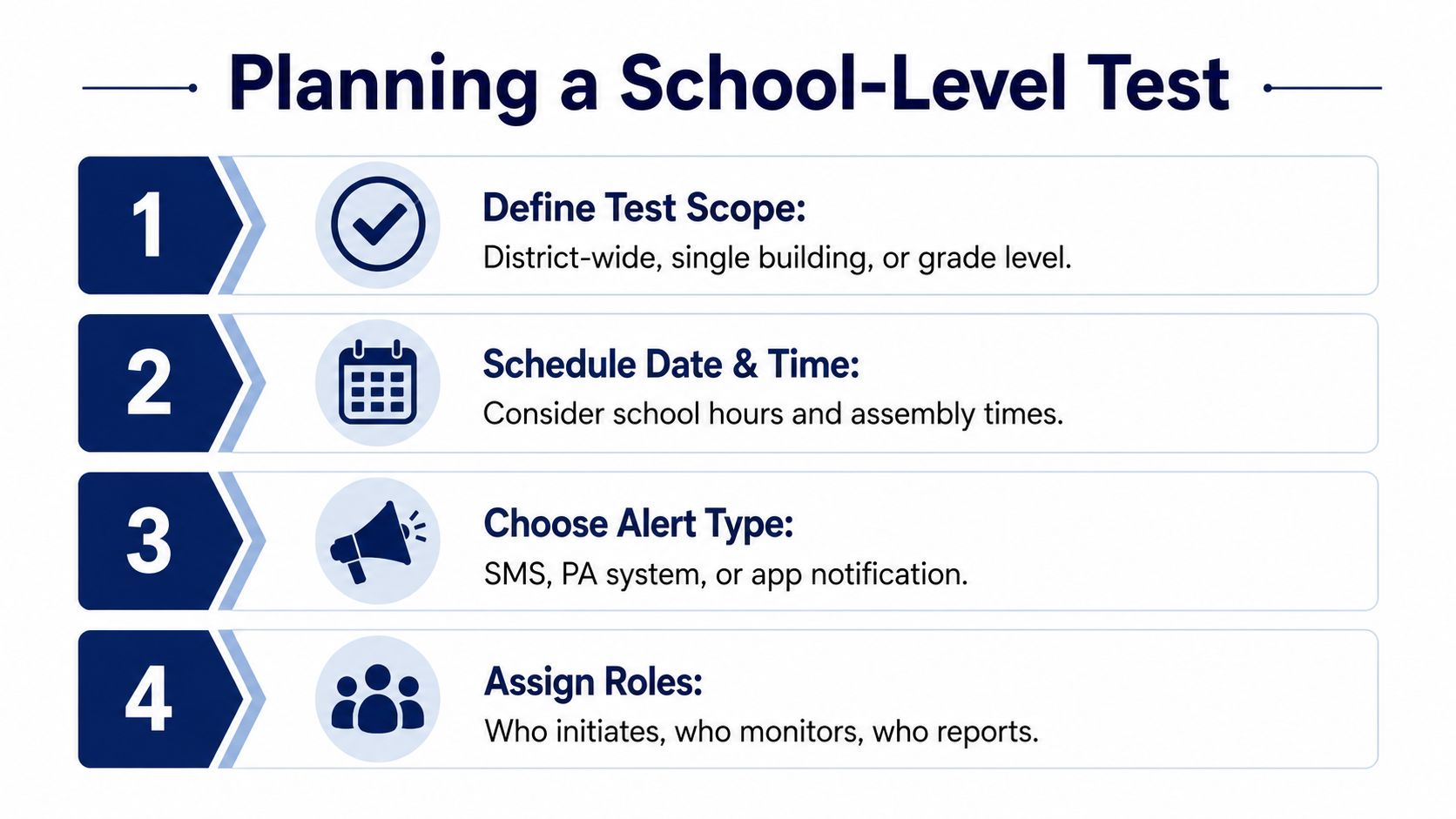
Schools looking to strengthen this area may also benefit from the practical communication lessons in Emergency Alerts Test: How Schools Plan and Evaluate Drills.
Community partners are actual partners
A law enforcement agency knowing where your school is does not equal emergency coordination. Sending first responders a copy of the plan is not the same as building an integrated preparedness system.
Prepared schools develop relationships before emergencies occur.
Key partners may include:
Law enforcement
Fire and EMS
Emergency management
Public health officials
Mental and behavioral health partners
Transportation providers
Hospitals
Local government
Community organizations
SchoolSafety.gov guidance emphasizes collaboration with community partners so school plans can benefit from outside expertise and integrate with local and regional systems. Preparedness means more than knowing whom to call. It means partners have planned together, clarified expectations, identified conflicts, and exercised together where appropriate.
The first serious conversation about working together should not happen during the emergency.
Preparedness Goes Beyond the Initial Response
Too many planning discussions stop at the first protective action. Lockdown. Evacuate. Shelter. Call 911. Those steps matter, but they are only the beginning.
Practice decisions, not just actions
Drills are important, but they are not the entirety of preparedness. A drill may help staff and students practice a specific action. Administrators and district leaders also need opportunities to practice decision-making.
They need to work through questions like these:
What happens when information is incomplete?
Who has authority at each stage?
When should protective actions change?
How is Incident Command established?
What happens when multiple campuses are affected?
When does transportation activate?
What information goes to parents?
When does reunification begin?
What happens if the preferred reunification site is unavailable?
These issues are often better explored through tabletop and functional exercises. The Department of Education describes an exercise continuum that moves from discussion-based activities, such as tabletop exercises, toward operations-based activities, such as drills and functional exercises. FEMA’s Homeland Security Exercise and Evaluation Program makes the same point. Exercises allow organizations to test and validate plans and capabilities in a controlled, lower-risk environment.
Prepared organizations do not only practice the easiest parts of the plan. They test the difficult parts.
Plan for accountability, reunification, continuity, and recovery
A prepared school looks beyond the immediate threat and asks, what happens next?
Student and staff accountability
One of the most basic responsibilities during an emergency is also one of the most difficult in practice: knowing where everyone is.
Schools need clear answers to questions such as:
What system will be used for accountability?
What is the backup?
Who reports missing, extra, or injured individuals?
Where is that information consolidated?
How is accountability maintained as the incident evolves?
Reunification capability
Reunification is another strong test of whether planning has become capability. Many schools have a reunification annex. Far fewer have fully tested the process under realistic conditions.
A workable reunification system requires answers to operational questions such as:
How will the site be activated?
Who has authority?
Who brings supplies and equipment?
How will transportation operate?
Where will students assemble?
Where will parents arrive?
How will identification be verified?
How will custody restrictions be handled?
How will traffic be managed?
What happens if families arrive without identification?
What if the planned location is unavailable?
Schools that want to deepen this capability can connect the work to broader emergency operations planning, staff training, communication workflows, and tabletop exercises through School Safety Solutions.
Continuity and recovery
The emergency does not end when the immediate threat stops. Students still need to be accounted for. Injured people may need care. Families need information. Media may arrive. Law enforcement may control part of the campus. The building may not be usable the next day. Students and staff may experience significant emotional impact.
The Department of Education explicitly includes recovery in comprehensive emergency planning and identifies academic, physical, emotional, and financial recovery as areas schools should consider before an incident occurs.
Preparedness asks not only what happens first, but what happens after that, and after that.
How Schools Evaluate and Improve Preparedness
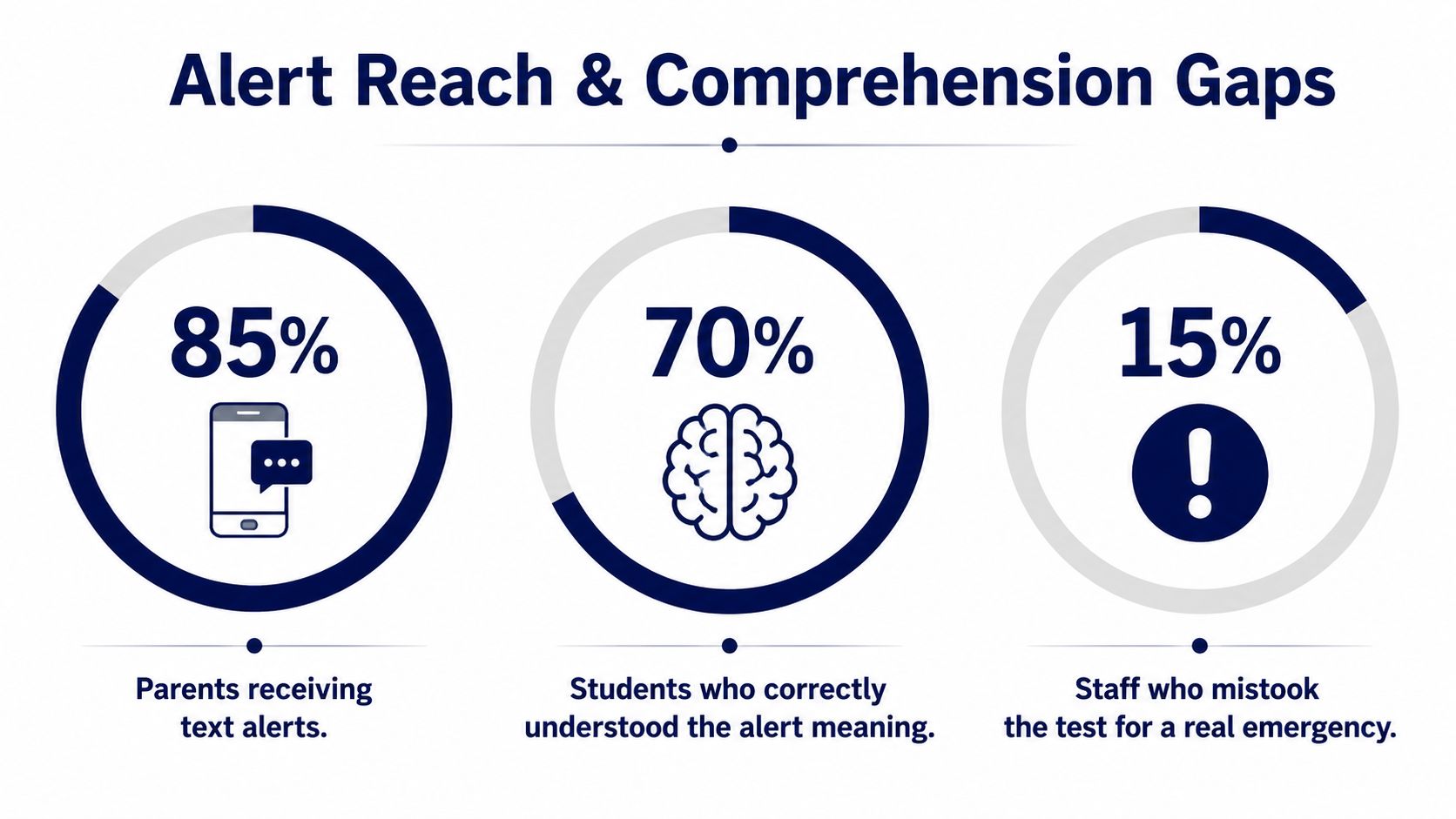
Preparedness is not static. Staff change. Administrators change. Buildings change. Technology changes. Community partners change. Student needs change. Threats change. Plans change.
A school that was well prepared a few years ago is not automatically prepared today.
Know your weaknesses
One sign of a prepared organization is that it can identify where it is not prepared.
That may sound counterintuitive, but it is essential. No emergency plan is perfect. No communication system is infallible. No exercise replicates every condition. Prepared organizations actively look for gaps.
FEMA describes exercise evaluation as the link between exercises and improvement planning. Organizations observe performance, collect data, identify strengths and areas for improvement, then use corrective actions to strengthen capabilities.
The goal of an exercise is not to prove that the organization is prepared. The goal is to discover how prepared it actually is.
Improve, then test again
Preparedness is a cycle:
Plan -> Train -> Exercise -> Evaluate -> Improve -> Re-test
This improvement mindset should shape every after-action review. The report is not paperwork that closes out the exercise. It is the bridge to the next version of the organization.
Examples of meaningful corrective action include:
Fixing a radio that failed during the exercise
Retraining staff who misunderstood a protocol
Revising a communication template that created confusion
Modifying a reunification site plan that caused traffic problems
Clarifying overlapping incident command responsibilities
Bringing transportation into the planning process earlier
Prepared organizations learn, correct, and test again.
Ask Your Team to Prove It
There is a simple exercise school leaders can use at the next safety meeting. Put the Emergency Operations Plan on the table and ask one question:
How do we know this works?
Not:
Is this written in the plan?
Did we complete the required training?
Did we conduct the drill?
Ask instead:
How do we know staff understand their roles?
How do we know communication reaches everyone?
How do we know community partners understand our procedures?
How do we know Incident Command will function?
How do we know transportation can support an evacuation?
How do we know student accountability works?
How do we know reunification can operate?
How do we know backup systems work?
How do we know lessons from the last exercise were corrected?
If the answer is, because we tested it, the school is moving toward preparedness.
If the answer is, because it is written in the plan, there is still work to do.
At School Safety Solutions, we believe effective school safety comes from connecting planning with implementation. That includes strong Emergency Operations Plans, common response protocols, Incident Command structures, staff training, community coordination, drills, tabletop exercises, reunification planning, evaluation, and measurable improvement.
The goal is not to produce a plan that looks prepared. The goal is to build an organization that can demonstrate preparedness when it matters most.
To discuss emergency operations planning, staff training, communication workflows, reunification planning, or exercises for your school or district, visit School Safety Solutions.


Comments