
The Preparedness Gap: Why Compliant Schools Stay Unprepared
In 2021–22, about 96% of U.S. public schools had written active-shooter plans, while only 27% reported comparable day-to-day readiness for an active-shooter scenario. The space between those two figures is the beginning of the preparedness gap, the distance between having a compliant plan and being able to execute it under pressure.
That distinction matters because a plan can pass review while staff still hesitate, communication systems still fail, and reunification procedures still depend on assumptions nobody has tested. Compliance establishes a baseline. Preparedness requires implementation. For school and district leaders, the practical question isn't only whether an emergency operations plan exists. It's whether the organization can make that plan work with the people, facilities, schedules, technology, and community partners available that day.
Table of Contents
The Preparedness Gap Between Written Plans and Real Capability
What Compliance Looks Like Without Preparedness - Questions that expose the gap
Why the EOP Is the Starting Point, Not the Outcome - Read every sentence as a claim
Drills That Test the Drill Instead of the System - A drill matrix for system coverage
After-Action Review That Actually Changes Something - A usable hot-wash checklist
Closing the Gap With the Plan Train Exercise Evaluate Improve Re-test Cycle
The Preparedness Gap Between Written Plans and Real Capability
The National Center for Education Statistics reported that, during 2021–22, 96% of public schools had written procedures for active shooters, and the same proportion reported written plans for natural disasters. Schools also reported written procedures for suicide threats or incidents at 94%, pandemic disease at 92%, and bomb threats or incidents at 92%. Nearly 90% reported post-crisis reunification procedures, while more recent federal data show that 92% reported updating their emergency operations plan annually or more frequently. These figures are documented in the NCES school safety and emergency preparedness data.
Those numbers describe formal coverage. They don't prove that the full school system can perform when conditions become confusing, time is limited, and normal communication channels are unavailable. The same NCES material found much lower day-to-day preparedness for specific scenarios, including active shooters at 27% of schools, active armed individuals with a non-firearm weapon at 26%, and chemical or industrial hazards at 19%. The contrast reveals a measurable difference between a broad plan on paper and readiness for the incident details staff may have to manage.
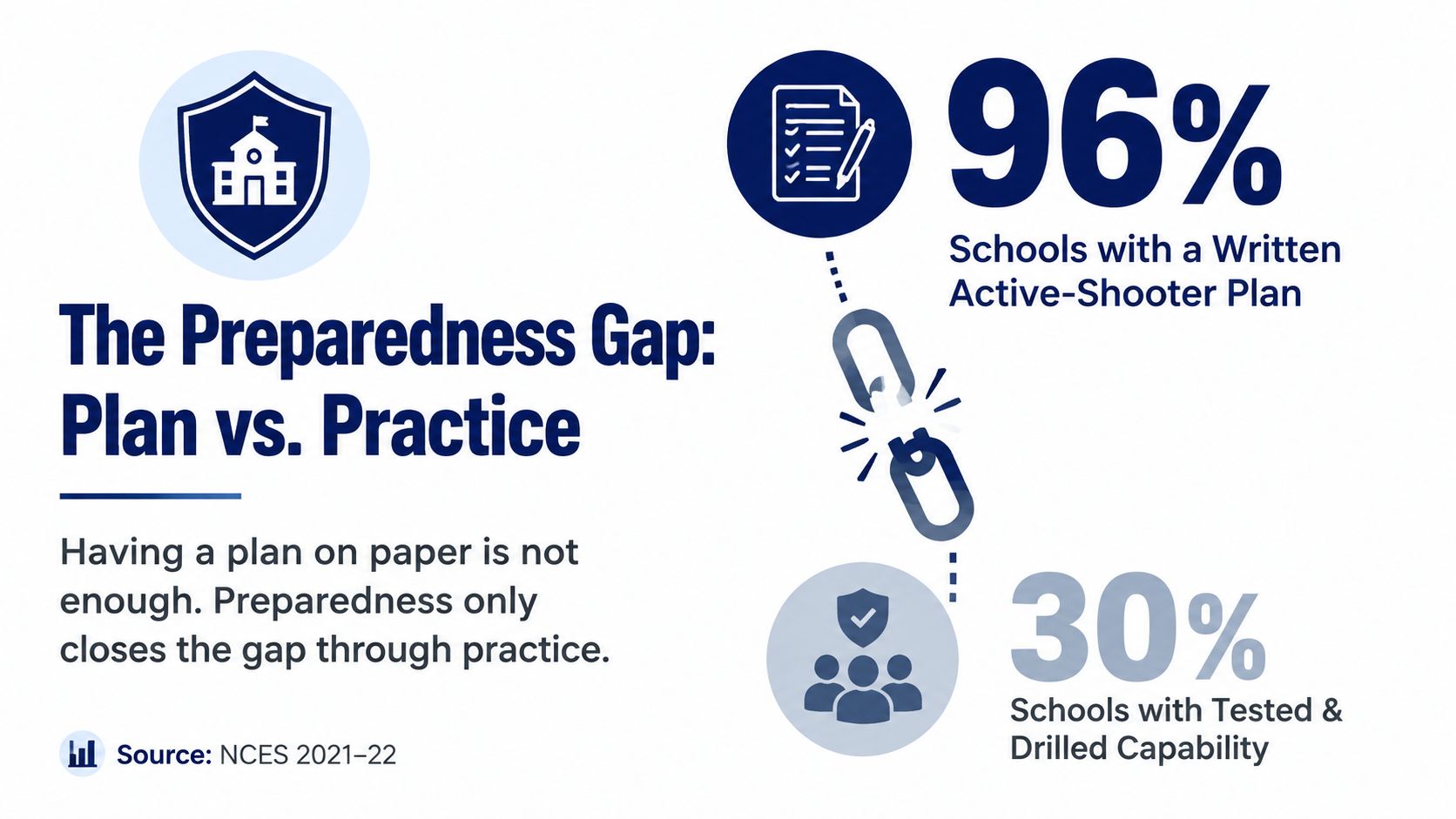
Practical rule: A document on a shelf isn't a capability. Capability is what people and systems can do under stress.
I treat the preparedness gap as an operational object that schools can examine. Leaders can compare written procedures with observable actions, role understanding, communication performance, accountability, reunification execution, and corrective-action follow-through. The question isn't whether a district has completed school safety compliance tasks. The question is where the plan's promises stop matching the organization's demonstrated performance.
What Compliance Looks Like Without Preparedness
A compliant emergency operations plan can still contain untested assumptions. Consider an elementary school plan that says office staff will lock the front vestibule from a workstation. During a walkthrough, the workstation is routinely left logged out, and the staff member assigned to the task isn't certain which access credentials or backup process applies. The written procedure exists, but the school hasn't verified the action with the actual workstation, the actual employee, and the conditions of a busy school day.
At a middle school, the reunification section assigns the assistant principal to lead student release while the same person is also listed as incident commander. The assignment looks organized on an ICS chart, but the two responsibilities compete for attention during the first operational period. Nobody has tested who makes decisions, who remains at the command post, who authorizes release, or who takes over when the assistant principal can't perform both jobs.
A high school may plan to use the bus loop for reunification and assume drivers will remain with their vehicles. The transportation contract, however, requires drivers to depart within ten minutes of dismissal. That conflict isn't a failure of motivation. It's a planning assumption that was never checked against the operating agreement.
These examples have the same structure. The plan records an expectation, but the organization hasn't tested whether the assigned person, schedule, technology, facility, or contract supports it. The discussion of what school district leaders can learn from research on school policing reinforces the broader need to examine how written policy connects with daily school operations.
Questions that expose the gap
For every major assignment, ask:
Actual owner: Who performs this task if the named person is absent?
Operating conditions: Can the person complete it during arrival, dismissal, lunch, or a schedule disruption?
Competing duties: Does the assignment conflict with incident command, supervision, accountability, or communication?
External constraints: Do transportation contracts, facility access rules, or partner procedures support the plan?
Verification: When did the school last test the assumption with the people who must carry it out?
The binder spine won't answer those questions. A tabletop, walkthrough, or functional exercise can.
Why the EOP Is the Starting Point, Not the Outcome
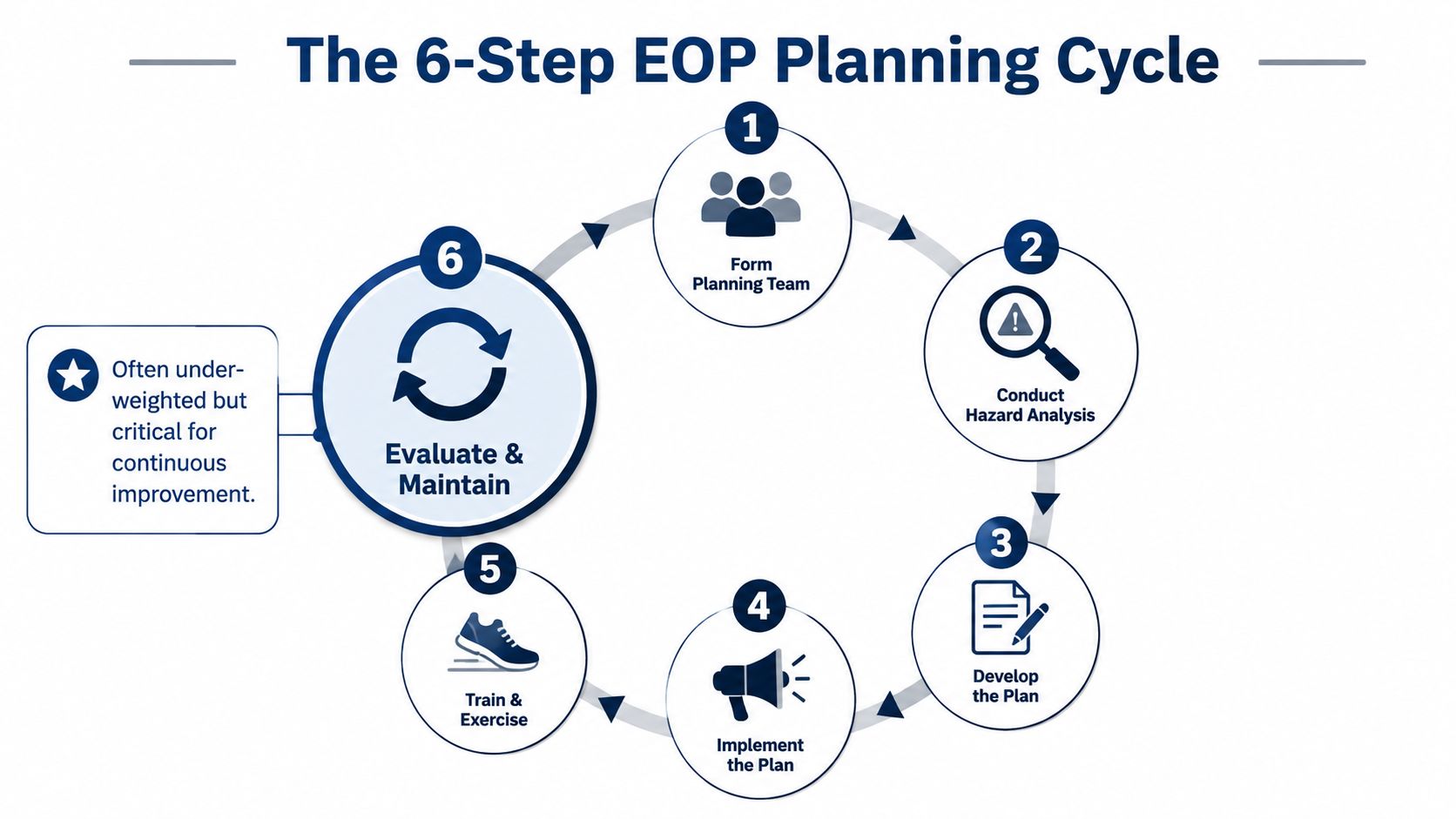
The federal Guide for Developing High-Quality School Emergency Operations Plans describes a planning process built around six steps:
Form a collaborative planning team.
Understand the situation.
Establish goals and objectives.
Identify courses of action.
Prepare, review, and approve the plan.
Implement and maintain the plan.
Many districts invest substantial effort in the first five steps and treat the sixth as an annual file review. That approach produces a document, but it doesn't necessarily produce organizational capability. The EOP is not the outcome. Organizational capability is the outcome.
Implementation means putting the plan into the routines of the people who will use it. It includes role-specific training, school emergency drills, tabletop exercises, communication tests, partner coordination, after-action review, and maintenance that responds to what those activities reveal. The plan documents how the system should work. Implementation determines whether it does.
Read every sentence as a claim
Every sentence in an EOP contains an assumption. A useful review discipline is to turn each assumption into a question:
Who exactly acts? Replace “the administrator” with a named role and a backup.
When does the action occur? Identify the decision point and the time window.
What tools are required? Check radios, keys, access systems, student information, transportation resources, and notification platforms.
Where does the action happen? Verify that the location is accessible and available during the relevant school activity.
What happens if the assumption fails? Document an alternate process instead of leaving the failure to improvisation.
Take a typical active-threat annex. “Hallway doors auto-lock” assumes the locking system functions, the door is included, and staff know how to verify it. “Radios work in the gym” assumes coverage, charged equipment, and a channel people can access. “The front office holds the master key” assumes someone can reach the office and knows which key applies. “Substitute teachers know the lockdown signal” assumes the school has provided usable orientation before the substitute needs it.
The review shouldn't be an exercise in blame. It should be a repeatable method for identifying claims and verifying them before the next exercise. A school emergency operations plan becomes useful when staff can connect its language to an action they understand, own, and have practiced.
A plan's weakest sentence is often the one nobody has assigned, demonstrated, or tested.
Step 6 also requires maintenance after personnel, facilities, technology, schedules, and community relationships change. A plan that worked for last year's staffing model can lose value when responsibilities move to people who weren't part of its development. Implementation keeps school emergency planning connected to the building as it exists, not merely the building described in the last approved version.
Training the People Who Actually Have to Act
Training isn't one presentation delivered to everyone. It has to reflect the different decisions, tools, and pressures assigned to each audience.
A teacher may need to manage classroom accountability, carry out the protective action identified by the district, communicate with the office, and maintain student supervision during a prolonged event. Office and front-desk staff may need to support notifications, visitor accountability, parent communication, and incident-command information flow. Transportation personnel may need to support evacuation, relocation, accountability, and reunification responsibilities. District leaders may need to coordinate incident command, continuity, public information, resources, and mutual aid.
Staff Group | Skill the Plan Assumes | Lowest-Cost Practice Format | Cadence |
|---|---|---|---|
Teachers | Classroom actions, accountability, and communications | Short micro-drills during faculty meetings | Repeated throughout the school year |
Office and front-desk staff | Visitor accountability, notifications, and command support | Office walk-throughs using actual systems and radios | Routine refreshers and after staffing changes |
Transportation | Evacuation, relocation, accountability, and reunification coordination | Bus-rider practice during arrival or transportation meetings | Repeated practice tied to operating changes |
District leaders | Decision authority, continuity, communications, and resource management | Facilitated tabletop exercises | Scheduled exercises with participating departments |
The lowest-cost practice is often the one that fits an existing workflow. A faculty meeting can include a brief role rehearsal. A transportation meeting can test how staff handle a relocation decision. An office walk-through can reveal whether the notification process depends on one person, one workstation, or one communication channel.
Standard Response Protocol is one example of a shared vocabulary, using Hold, Secure, Lockdown, Evacuate, and Shelter. The vocabulary can reduce ambiguity, but it doesn't tell every employee what their specific role requires in the first moments of an event. A teacher, office employee, bus driver, and district leader may hear the same term and have different actions to perform.
A poster doesn't create preparedness. People do.
New employees and substitutes need a practical way to learn the language and the role attached to it. Existing employees need reinforcement, not just a slide deck from orientation. Students need opportunities to respond to the words and actions in a calm, age-appropriate way. Common language becomes valuable when it becomes common practice.
The reflection on serving as a lead trainer with the I Love U Guys Foundation offers related context for how shared protocols can support school safety training. The operational test remains simple: can each participant explain what the plan requires that person to do, and can the person demonstrate it without waiting for someone else to interpret the procedure?
Drills That Test the Drill Instead of the System
Participation numbers show that schools conduct drills, but frequency alone doesn't show system coverage. NCES reported that in 2023–24, 97% of public schools conducted or planned lockdown drills, while 95% conducted or planned evacuation drills and 95% conducted or planned shelter-in-place drills. Those figures come from the NCES 2023–24 school safety data.
The harder question is what each recurring drill tests. If the same hallway, signal, observer, staff pattern, and conditions repeat every semester, the school may be confirming a familiar routine without examining the assumptions that make the broader system work.
Consider a facilitated tabletop prompt: a hostile event has disrupted the bus fleet, students are being rerouted to an alternate reunification site, and several parents are already driving toward campus without waiting for instructions. The purpose isn't to rehearse tactical response. It's to examine decision-making, communication, accountability, transportation coordination, and release authority.
The facilitator can move the team through the sequence:
Initial notification: Who receives the first report, verifies it, and initiates the response?
Transportation decision: Who activates transportation, identifies available vehicles, and approves the route?
Site movement: Which entrance does the alternate site use, and what happens if law enforcement closes that road?
Accountability: How are students, staff, and transportation personnel accounted for if the normal system is unavailable?
Family communication: Who drafts, approves, and sends information while parents arrive unannounced?
Release authority: Who confirms that a student may be released, and who resolves an unclear record?
Termination: Who determines when the reunification process changes or ends?
Within a short conversation, the team may discover that the person listed on the planning committee isn't in the building that day, radios fail in a particular area, the reunification map names a parking lot also used as an evacuation muster point, or two departments each assume the other manages parent communication.
A drill matrix for system coverage
Drill Type | Intended System Test | Likely Exposed Assumption | Suggested Re-Test Cadence |
|---|---|---|---|
Lockdown drill | Protective action and classroom accountability | Staff outside classrooms, substitutes, or special activity locations aren't included | Re-test after the identified gap is corrected |
Evacuation drill | Movement, accountability, and site management | The alternate location isn't usable during the actual schedule | Re-test when the site or route changes |
Shelter-in-place drill | Notification, movement, and supervision | The chosen space doesn't support every affected group | Re-test after facility or staffing changes |
Transportation tabletop | Relocation, buses, accountability, and reunification | Transportation authority, routes, or contracts conflict with the EOP | Re-test after corrective actions are assigned |
Communications exercise | Primary and backup notifications | The backup channel depends on the same failed infrastructure | Re-test after the communication process changes |
The Department of Education describes an exercise continuum that includes tabletops, simulations, drills, functional exercises, and other activities. Federal guidance also identifies exercises as a way to validate courses of action and identify gaps and weaknesses. A school doesn't need every activity to be large or disruptive. It does need the activity to test the system the plan claims to support.
The purpose of an exercise isn't to prove that the plan works. The purpose is to discover where it doesn't.
Varying the conditions makes the drill more useful. A blocked primary exit, substitute teacher, missing administrator, late bus arrival, or public-address failure can test whether the plan remains usable when routine assumptions disappear. The objective isn't realism for its own sake. It's evidence about which plan clauses function and which need revision, training, or a different assignment.
After-Action Review That Actually Changes Something
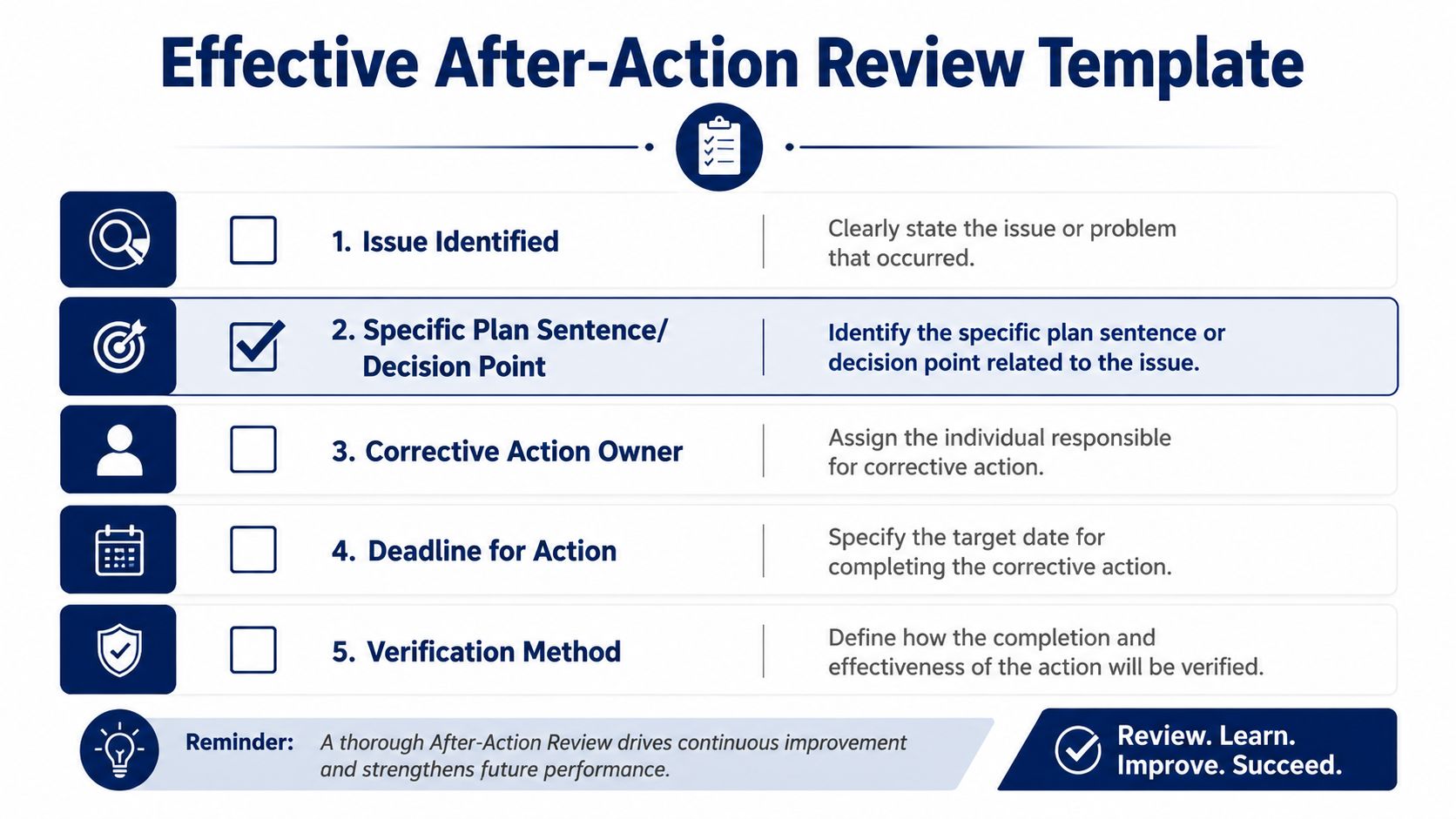
An after-action review should convert observations into dated, owned changes. The review is useful when the team can identify what was supposed to happen, what happened, what worked, what didn't, why the difference occurred, and how the school will verify the correction.
Weak findings sound responsible but don't create accountability:
“Improve communication.”
“Review procedures.”
“Provide more training.”
“Clarify reunification.”
Each statement needs a specific failure and an assigned response. If the office and district communications team both assumed the other would send the family message, the corrective action might assign message ownership, identify the approval path, and place the revised process into the next communications exercise. If a radio dead zone prevented a critical notification, the action should identify the affected location, assign someone to test an alternative, set a deadline, and schedule verification.
A usable hot-wash checklist
Issue identified: What observable problem occurred?
Plan sentence or decision point: Which exact instruction, assignment, or choice failed?
Cause: Was the issue caused by unclear ownership, unavailable equipment, conflicting duties, missing training, or another observable condition?
Corrective action: What single change will address the issue?
Owner: Which person or role is responsible for completing it?
Deadline: When must the action be complete?
Verification method: How will the team know the change worked?
Re-test date: When will the school exercise the corrected process?
SchoolSafety.gov resources describe tabletops as tools for validating and updating EOPs, policies, and procedures while identifying issues, gaps, and improvement areas. Finding a weak point during an exercise is better than finding it during an emergency, because the team still has time to change the plan and test the correction.
A meaningful review follows this discipline: Plan → Train → Exercise → Evaluate → Improve → Re-test. Preparedness is a cycle, not a destination.
Closing the Gap With the Plan Train Exercise Evaluate Improve Re-test Cycle
The opening question for a district leader shouldn't stop at “Are we compliant?” It should continue with “Are we prepared?”
The answer comes from a cycle that produces evidence:
Plan: Revise the EOP section that failed during the last tabletop.
Train: Work with the staff members whose roles or decisions were unclear.
Exercise: Design the next activity around the gap the previous drill missed.
Evaluate: Record the failed action, cause, and operational consequence.
Improve: Assign an owner, deadline, and specific corrective action.
Re-test: Put the verification date on the calendar before the team leaves the meeting.
The cycle only closes when the improvement is measured again. Filing a memo doesn't establish readiness. Updating a binder doesn't demonstrate capability. A school knows the gap is shrinking when people understand their roles, departments coordinate, communication pathways work, reunification responsibilities are clear, and exercises produce changes that survive a later test.
This approach also gives leaders a practical way to prioritize limited time. Start with the assumption that carries the greatest consequence if it fails, then test it with the people who must implement it. The discussion of building a culture of prevention, protection, and preparedness aligns with that operational view of school safety.
Compliance puts the plan on paper. Preparedness puts the plan into practice. The distance between the two is the preparedness gap, and it grows or shrinks through disciplined repetition, not annual paperwork.
School Safety Solutions helps K–12 organizations strengthen the capability behind their plans through emergency operations planning, role-specific school safety training, Standard Response Protocol support, incident command exercises, reunification planning, behavioral threat assessment support, and after-action review. Visit School Safety Solutions to discuss an assessment, tabletop exercise, training cycle, or practical next step for closing the gap.


Comments