
Active Shooter Protocol for Schools: A Stepwise K-12 Guide
If you're a superintendent, principal, or safety coordinator staring at a draft emergency plan on your desk, the hard part is not finding the phrase active shooter protocol. The hard part is making sure the plan works in a K-12 building, with children, substitutes, aides, counselors, bus riders, and after-school programs all moving through the same space at once.
That is the real job. A usable protocol does not live as a poster or a binder tab. It lives inside a broader school emergency operations plan, with clear roles, plain language, and practiced decisions that staff can make in seconds. Federal guidance is useful, but schools only benefit when that guidance is translated into classroom reality, hallway behavior, student accounting, and reunification logistics.
The first few minutes matter most. In many incidents, the people already inside the school may have to make the earliest and most important decisions before law enforcement arrives. That is why a strong school protocol has to connect prevention, common emergency language, immediate response, communication, and recovery.
Table of Contents
What an Active Shooter Protocol Really Covers in K-12 - K-12 reality changes the plan
Why the Time Data Should Change How You Plan - What the newer FBI reporting adds
Building the Prevention and Preparedness Layer - Prevention is not prediction - Use one vocabulary across the building
How Standard Response Protocol and Avoid, Deny, Defend Work Together - Institutional response and individual response are not the same thing
Avoid, Deny, Defend Translated for Classrooms and Hallways - Avoid means move first, then account for people - Deny means lock, barricade, and stay quiet - Defend is the last resort, not the headline
Roles, Communications, and the Law-Enforcement Handoff - Pre-assign the decision chain - Build communication before the emergency
Drills, Tabletop Exercises, and After-Action Review - Match the exercise to the audience - Close the loop after every exercise
What an Active Shooter Protocol Really Covers in K-12
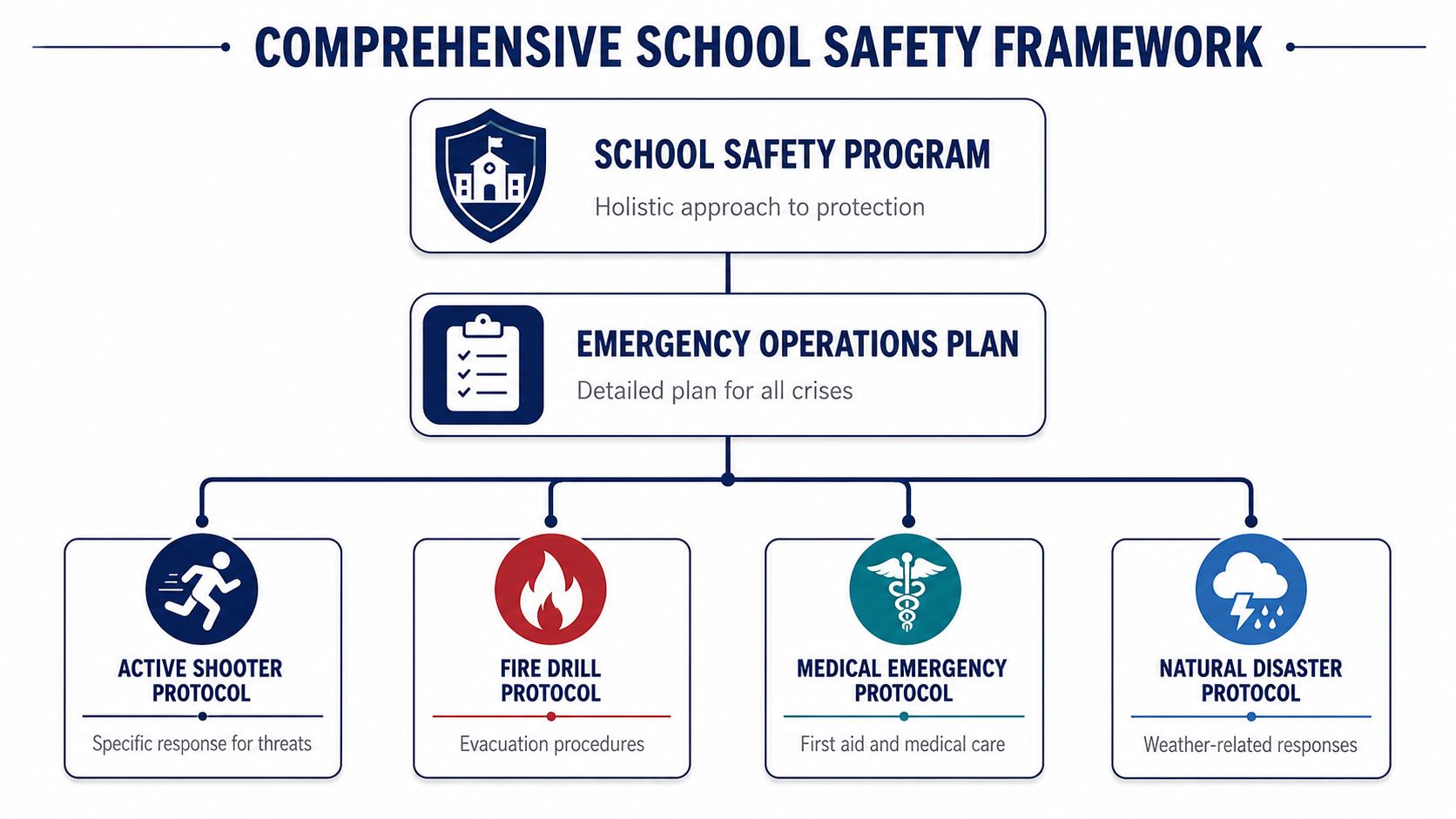
An active shooter protocol in a school is not a standalone document. It is a narrow operational layer inside a larger safety program, and it only works when people know who decides, who communicates, who teaches, and who trains before anything happens.
In a K-12 setting, those functions matter more than almost any wall chart. The principal may be the decision-maker in a drill or incident, but communications often involve the office, district leadership, and law enforcement. Teaching the protocol means more than one staff in-service, because classrooms, cafeterias, hallways, buses, substitutes, and after-school programs all need the same basic language.
A practical school protocol also has to recognize a harder truth. During an active threat, staff inside the building may need to make immediate decisions with incomplete information. That means the protocol must be simple enough to use under stress and specific enough to guide action in real spaces.
K-12 reality changes the plan
Federal guidance is written for people under stress, but a school has extra layers that adult workplaces do not. Students have different ages and abilities, some staff support students with mobility, sensory, or communication needs, and many buildings also serve preschool, community programs, and evening events. Those realities change the way evacuation, hiding, and reunification need to be organized.
That is why a school protocol has to answer practical questions, not just naming questions. Which adults can make a quick call? How do visitors and substitutes get the message? What happens when the nearest exit is not accessible for one student group? What if a class is on the playground, in a portable, at arrival, or transitioning between periods? If those answers are not written down and practiced, the school is still improvising.
Practical rule: If a protocol cannot be explained clearly to a new staff member in a minute or two, it is not ready for a real crisis.
The fastest way to see the difference is to think in layers. Protocol is the action set. Plan is the broader system. Training is the muscle memory. Communication is the glue.
That is the standard worth using, because a protocol that lives only on paper will not hold up once children are in the room and the intercom is live.
Why the Time Data Should Change How You Plan
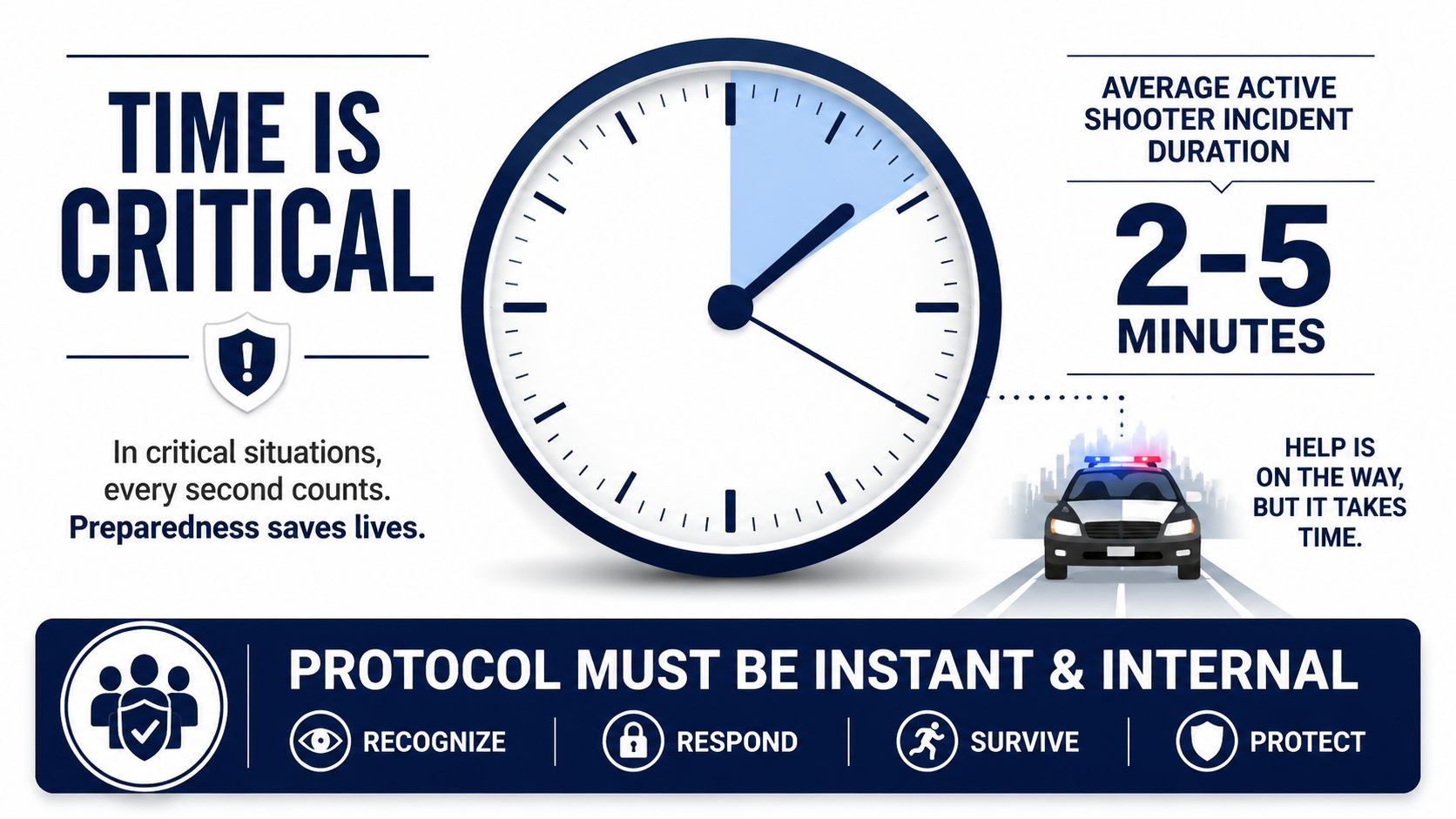
The time data is the reason school leaders have to treat this as an internal response problem first. The FBI's long-running incident study found that, in 160 incidents from 2000 to 2013, 60% ended before police arrived, and among cases where duration could be measured, 44 of 63 incidents, or 69%, ended in 5 minutes or less, while 23 ended in 2 minutes or less (FBI quick reference guide). That is not enough time to wait for outside help to solve the first decision.
Think about what that means in a school. A teacher may be in a hallway with students. A class may be at recess. A cafeteria may be full. A bus may be arriving. A substitute may be covering a classroom. An administrator may be on the opposite side of campus. In those first moments, the people already inside the building may have to act before they have complete information.
The broader pattern points the same direction. The FBI also reported 486 people killed and 557 wounded across those incidents, with 70% occurring in commerce/business or education settings (FBI quick reference guide). The takeaway for schools is simple, the protocol has to help staff act immediately, not after discussion.
What the newer FBI reporting adds
More recent FBI reporting shows the threat profile keeps changing. In 2025, the FBI designated 34 active shooter incidents, a 42% increase from 24 incidents in 2024, though still below the five-year average of 43 incidents per year (FBI 2025 active shooter report). The same report said nearly 68% of incidents involved planning and preparation by the shooter, up from 58% in 2024 (FBI 2025 active shooter report).
That combination matters. It means schools have to prepare for both speed and planning, which is exactly why the prevention side and the response side belong in the same conversation. A district that only drills lockdown language without reviewing threat assessment, communication, and reunification is leaving gaps.
The protocol should not assume someone else will buy time for you. In a school, the first 911 call is important, but the first safe decision is more important.
A separate law-enforcement benchmark says these events are typically over in 4 to 6 minutes, with an average delay of 2 to 4 minutes before someone calls 911 (law-enforcement facts sheet). That is why the best protocol design feels almost boring on paper. It gives people a small set of actions they can remember while their attention is under pressure.
The planning lesson is blunt. Build for the first minutes, not the after-action press release.
Building the Prevention and Preparedness Layer
The strongest active shooter protocol starts before anyone hears a threat. That layer lives in the school climate, the behavioral threat assessment process, the emergency operations plan, and the habits staff use every day to notice and report concerning behavior early.
Prevention is not prediction
Schools should be careful with language here. Prevention means identifying concern early, connecting the right adults, and using support, supervision, and intervention to reduce risk. Prediction is something else, and schools cannot promise to predict violence from a single behavior or warning sign.
A good threat assessment team is cross-functional. It usually includes administrators, counselors, school psychologists or mental-health staff, safety personnel, and, when appropriate, district or law-enforcement partners. The point is not to punish a student for concern. It is to understand context, collect facts, and decide on support and safeguards.
That is why behavioral threat assessment belongs in the same safety continuum as emergency preparedness. Schools sometimes separate these conversations, prevention over here and response over there. In practice, they should be connected. A comprehensive school safety system should be working every day to identify and manage concerns before violence occurs while also preparing staff and students to respond effectively if prevention efforts do not stop the event.
The protocol also has to live inside the district's broader emergency operations plan. If the active shooter section is written separately from communication, reunification, and student accounting, people will waste time figuring out how the pieces fit together during a real event. That is especially true in schools with multiple campuses or shared staff.
Use one vocabulary across the building
Many districts already use a shared language for emergencies, and that helps. When staff and students know the words that mean hold, secure, lockdown, evacuate, or shelter, they spend less time translating and more time acting. Consistent language also helps substitutes, paraprofessionals, bus drivers, coaches, and after-school staff who may not know the building as well as full-time employees.
This is one reason many schools adopt the Standard Response Protocol model. A common institutional vocabulary gives the entire organization a shared protective action. If a lockdown is called, people should not have to decode what that means in the moment.
A practical review should cover these points:
Threat assessment coverage: Who sits on the team, how concerns are routed, and how follow-up is documented.
Training access: How substitutes, aides, office staff, and coaches learn the protocol before they need it.
Visitor and vendor procedures: How guests are informed of emergency expectations and what they do during a lockdown or evacuation.
Accessibility planning: How the school supports students and staff with mobility, sensory, or communication needs.
Communication readiness: Whether the district can reach people through more than one channel if the first one fails.
Schools often miss the same gaps, outdated contact trees, plans that only exist on a shared drive, or a single communication channel that assumes everything will work perfectly. Those are small failures until the day they are not. A protocol that cannot survive a broken network, a new substitute, or a locked-out door is not ready.
For a wider prevention mindset, this earlier piece on building a culture of prevention, protection, and preparedness fits naturally with the operational work here.
The right benchmark is simple. If prevention and preparedness do not show up in staff routines, the response plan will always be heavier than it should be.
How Standard Response Protocol and Avoid, Deny, Defend Work Together
Schools sometimes talk about emergency response models as though they have to choose one philosophy over another. In practice, that framing creates a false choice.
A school may use a shared institutional response model, such as Hold, Secure, Lockdown, Evacuate, Shelter, while also training adults to understand Avoid, Deny, Defend as an individual decision path inside an unfolding active threat. These approaches do not have to compete.
The school provides the common direction. The individual still may need to respond to the conditions immediately in front of them.
Institutional response and individual response are not the same thing
That distinction matters in K-12. Imagine an active threat is identified inside the building and the school initiates a lockdown. That is the institutional response. It communicates a common protective action across the campus.
For many classrooms, following the lockdown procedure may be the safest choice. But emergencies do not unfold uniformly. A teacher and students might already be outside. A class may be transitioning through a hallway. Someone may be in a common area near an exterior exit. Another classroom could be directly adjacent to the threat.
Those individuals may have information that the person initiating the institutional response simply does not have. That is where individual decision-making matters.
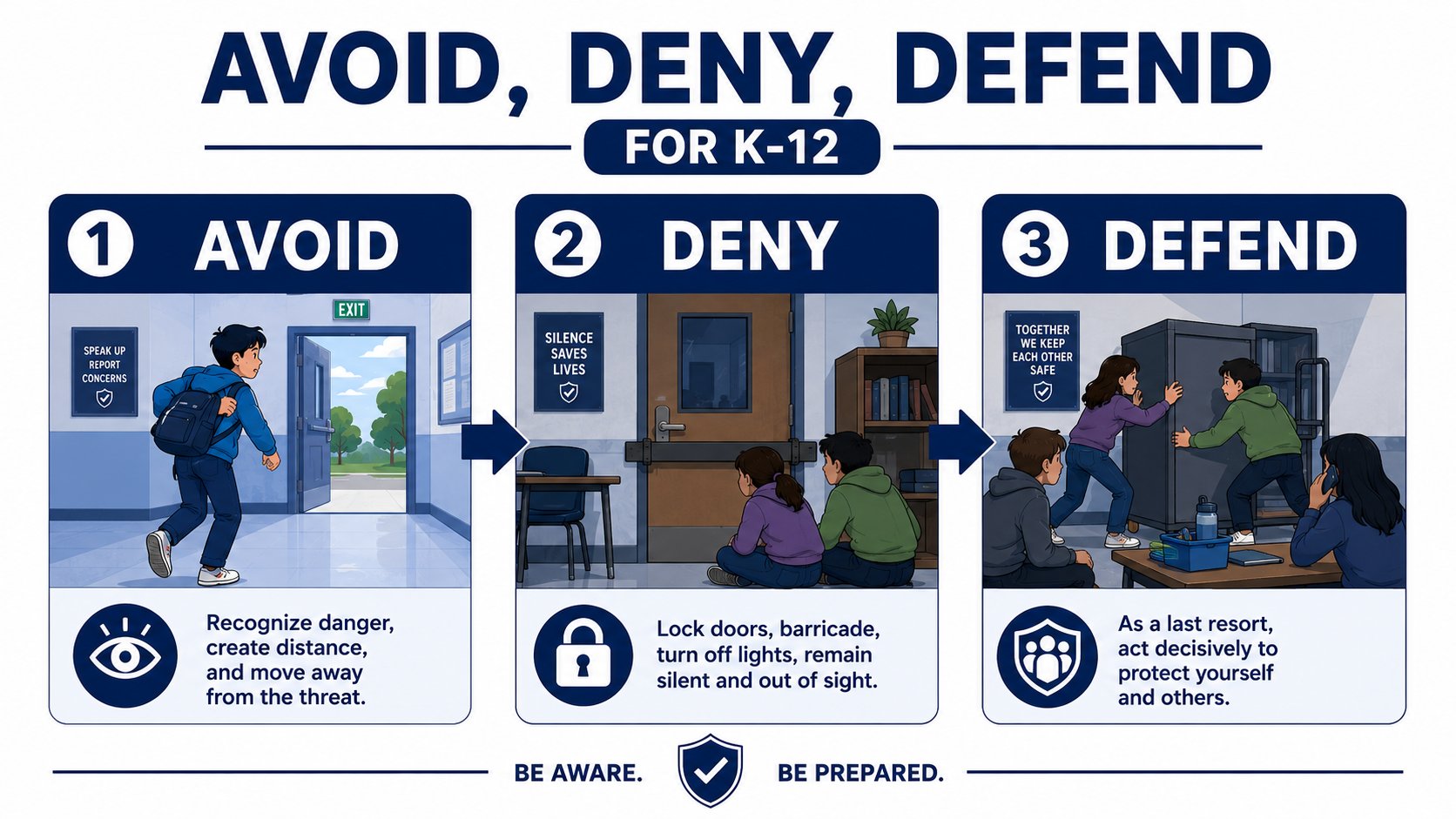
Avoid means recognizing when safely moving away from danger is the best available option.
Deny means preventing or delaying access to your location when evacuation is not safe.
Defend is a last resort when confronted directly with an immediate threat and safer options no longer exist.
These are not replacements for the school's emergency protocol. They are an extension of it. The institution establishes the common response. The individual retains the ability to adapt to actual conditions.
That point is worth emphasizing because emergencies are dynamic. A decision that was appropriate 30 seconds ago may no longer be appropriate as the situation changes. Training should prepare people to understand both the institutional expectation and the individual options available when conditions require them to adapt.
Avoid, Deny, Defend Translated for Classrooms and Hallways
The Avoid, Deny, Defend sequence works in schools because it gives people a short decision path, not a long debate. The challenge is translating those three options into K-12 spaces without turning them into adult tactical language that younger students cannot use.
Avoid means move first, then account for people
Avoid is the best option when a safe exit is available. In a school, that usually means the nearest safe exit, not the front office, not the main entrance, and not a route someone chose yesterday on a floor plan. FEMA's school guidance emphasizes leaving belongings behind, keeping hands visible, and calling 911 only when it is safe to do so (FEMA IS-907 student manual).
Teachers also need to think about the end of evacuation, not just the move itself. Once students reach the rally point, the adult who has them has to account for the group and report missing or injured individuals through the district's process. In a real K-12 evacuation, that accounting step is what stops confusion from spreading.
This is also where pre-planning matters. Staff should know alternate rally points, who receives accountability reports, and what to do if their normal route moves them closer to danger rather than farther away.
Deny means lock, barricade, and stay quiet
If evacuation is not safe, denying access becomes the priority. CISA's guidance says to use available cover and concealment, and to shelter only in a secure area with locked access (CISA action guide). FEMA's school manual adds the classroom realities, block entry, lock doors, remain quiet, and silence cell phones or pagers (FEMA IS-907 student manual).
That sounds simple, but the details matter. Staff need to know how their particular door works, whether the door can be locked from the inside, and how they will account for a student who uses a mobility device or has sensory needs. If a room cannot be secured quickly, the school needs another plan for that space.
The FBI Law Enforcement Bulletin also reinforces the classic school move, lockdown procedures should minimize the target profile, and staff should wait for police to neutralize the situation (FBI Law Enforcement Bulletin).
Defend is the last resort, not the headline
Defend only belongs in the last-resort category. The FBI's guidance says coordinated, improvised-force tactics may be used when escape and hiding are not safe, and that teamwork and surprise can help incapacitate an attacker (FBI active shooter preparedness guidance). That is not a classroom lesson for small children, and it should not be framed that way.
For schools, the important part is decision-making. Staff need to understand that if the threat is direct and no safer option exists, their response shifts from concealment to survival. That principle has to be covered in training carefully, with legal and law-enforcement input, and never as a standalone technique.
Best practice: Teach students and staff the first two options clearly, then make sure adults understand the last-resort threshold without dramatizing it.
For K-12 buildings, the value of Avoid, Deny, Defend is that it gives everyone a simple structure under stress. The weakness is just as important, it only works if the building has already practiced where those choices are made.
Roles, Communications, and the Law-Enforcement Handoff
A school incident becomes much harder when nobody knows who owns the message. The safest districts pre-assign roles through their Incident Command System, so the incident commander, communications lead, operations lead, logistics lead, and planning lead are identified before anything unfolds.
Pre-assign the decision chain
In practice, that means the principal or designated leader does not have to invent the chain of command during the event. The operations function supports room security and movement, communications handles internal and external alerts, logistics manages resources and access, and planning tracks what is happening and what may happen next. When officers arrive, those roles do not disappear, they shift into a handoff.
That handoff matters because law enforcement needs clear, usable information. CISA advises staff to alert 9-1-1, maintain situational awareness for possible secondary attacks, render first aid only when safe, and then follow law-enforcement instructions on arrival (CISA action guide). That sequence keeps the school from freezing after the first contact with responders.
Schools should also decide in advance who can authorize a lockdown, who can announce an evacuation, who speaks to district leadership, and who owns family communication once the immediate threat is under control. If that chain is vague on paper, it will be slower in real life.
Build communication before the emergency
The communication plan should include the obvious channels and the awkward ones. That means 911 call criteria, intercom or PA scripts, parent-notification templates, and a rule about who can post publicly during an unfolding event. Social media is not a live command center, and real-time posting can create confusion faster than it creates reassurance.
A school also needs a clear instruction for the moment when officers arrive. The FBI Law Enforcement Bulletin recommends detailed information through 911 first, then remaining quiet until a recognized voice says it is safe (FBI Law Enforcement Bulletin). That is a simple line, but it prevents staff from making assumptions about who is outside the room.
The district should also rehearse communication assets in advance, not just write them. A notification template that sits untouched for a year often reads awkwardly in a real crisis, and awkward messages slow action. One that has been tested, edited, and assigned to a specific owner is far more useful.
Channel | Pre-Built Asset | Owner | Rehearsal Cadence |
|---|---|---|---|
911 call | Decision criteria and call script | Principal or designee | Reviewed each semester |
PA or intercom | Short lockdown or evacuation script | Office manager or communications lead | Tested during drills |
Parent notification | Plain-language message template | District communications | Updated before school starts |
Staff radio | Short status code or plain-language alert | Safety lead | Checked during table-top practice |
For districts that want to tighten the school-policing and coordination side of planning, this discussion of what district leaders can learn from research on school policing is a useful companion.
The goal is not to make communication fancy. It is to make it dependable when the building is loud, the phones are lighting up, and the first responders are on the way.
Drills, Tabletop Exercises, and After-Action Review
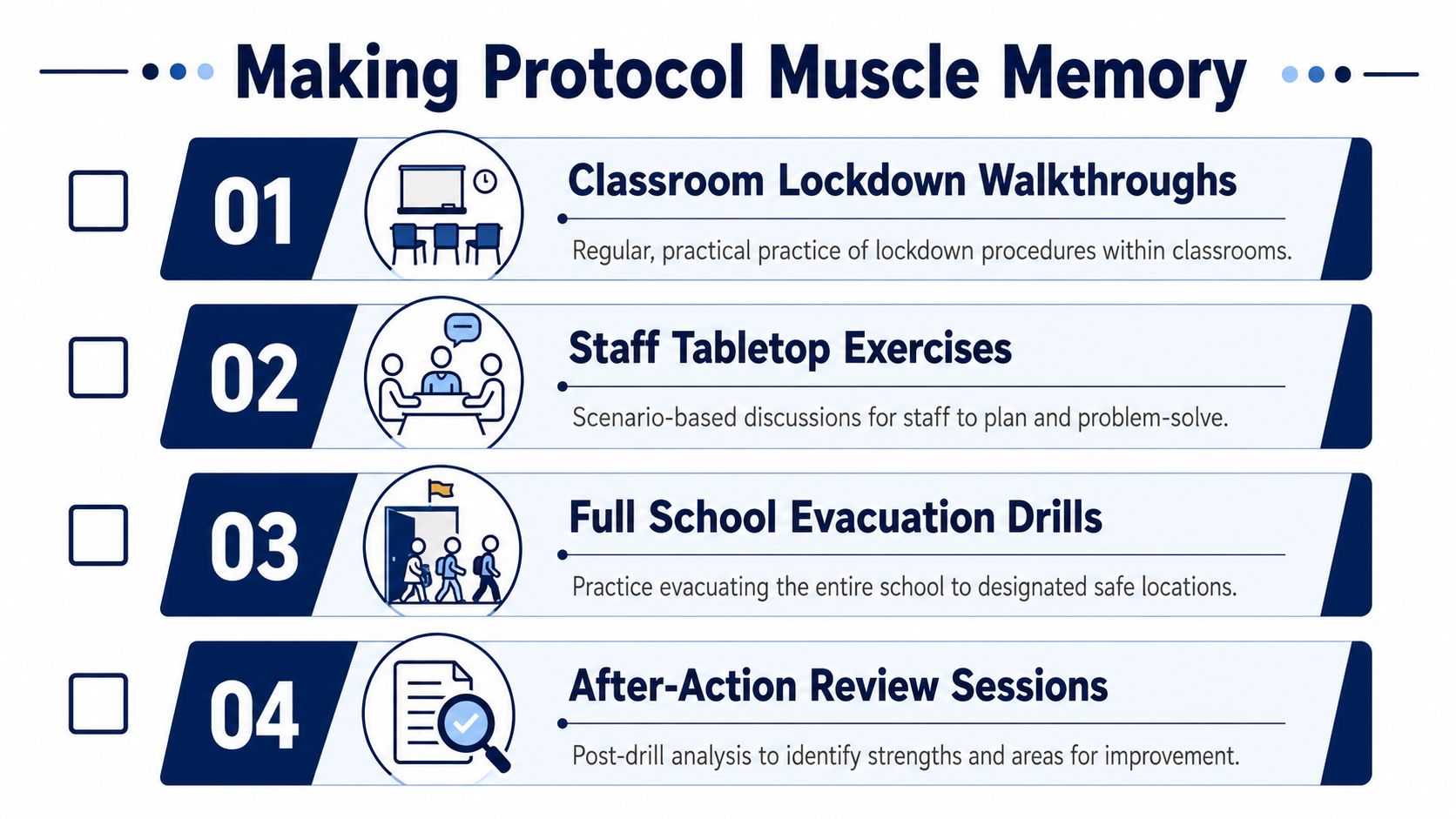
A written plan does not become real until people rehearse it in the spaces they use every day. The best schools use different kinds of practice for different audiences, because a classroom drill, a staff tabletop, and a full-building exercise solve different problems.
Match the exercise to the audience
You do not need to run every drill at full intensity to get value from it. Younger students usually need calm, simple, age-appropriate practice. Staff need tabletop exercises, which are discussion-based sessions where leaders walk through a scenario and make decisions together. Administrators and the threat assessment team also need communication drills, because that is where message timing and role clarity are tested.
Each format serves a different purpose. A classroom drill can help students and staff become familiar with protective actions. A staff tabletop can place educators in realistic situations and ask them to work through decisions. A leadership tabletop can test communication, incident command, coordination with first responders, student accounting, family notification, and reunification.
The point is to find the small failures before a real event does. A door that does not lock cleanly, a radio that will not reach the far parking lot, or an attendance system that slows accounting can all become major problems under stress. Those are exactly the kinds of issues that turn a decent policy into a brittle one.
Drill design should build confidence, not fear. Advance notice for staff, age-appropriate language for students, and accommodations for people who need them are part of responsible practice, not a sign of weakness.
Close the loop after every exercise
After-action review is where schools get better. Ask these questions in order: what happened, what was supposed to happen, where was the gap, what worked well, who owns the fix, and when will it be re-tested. If the answer to the last question is vague, the fix probably will not stick.
A strong review should end with a real assignment, not a generic note to “improve communication.” That might mean adjusting a door hardware issue, rewriting a notification message, or re-training substitutes on how to respond if they are alone with students. If the issue affects multiple buildings, it should go to the district level.
This part is easy to overlook. An after-action report that identifies problems but does not assign responsibility for correcting them is simply documentation. Improvement happens when lessons become action.
For schools that use outside partners for training and exercises, the value comes from realism without theatrics. This perspective aligns well with the kind of practical work described in School Safety Solutions' I Love U Guys Foundation trainer experience, especially where staff need a shared language and a repeatable process.
Drills are not a compliance checkbox. They are the only honest way to see whether the plan can survive noise, hesitation, and imperfect conditions.
What to Ask Before the Next School Year Starts
Before the next school year starts, leadership should ask a few hard questions, not to find fault, but to find the gaps that still need work. When was the active shooter protocol last reviewed against current federal guidance? Who owns each section, and do substitutes, paraprofessionals, and support staff know what to do without hunting for a binder?
Ask how accessibility needs are documented, how the protocol connects to reunification, and whether the district has confirmed state-specific requirements with the education agency and legal counsel. Ask a more direct operational question too: what happens during our first few minutes? If those answers are unclear, the plan is not finished yet.
A qualified school safety consultant can help a district test the plan, run tabletop exercises, review assessment gaps, and strengthen reunification planning without turning safety into theater. That kind of outside support is useful when leaders know the plan needs a second set of eyes, especially before the year gets busy.
Three takeaways matter most. The first minutes are critical. Prevention and response belong together. Practice is what turns a document into a usable protocol.
School Safety Solutions helps K-12 leaders strengthen prevention, protection, and preparedness through practical assessment, training, tabletop exercises, Standard Response Protocol implementation, behavioral threat assessment support, and reunification planning. If your district wants a calm, working review of its active shooter protocol and broader emergency readiness, visit School Safety Solutions or call 512-387-6729 to talk through next steps.
Comments